
Classical Guitar

Classical Guitar Lessons, Interview, News, Tips & More

Classical Guitar
You are here: Classical Guitar » Classical Guitar Technique » Angled vs. Straight Left Hand Position

Angled vs. Straight Left Hand Position
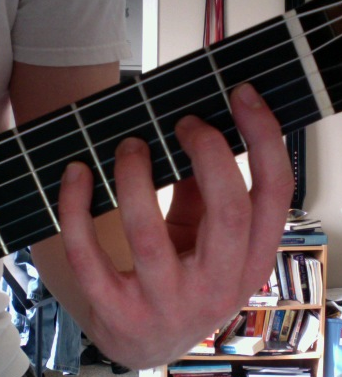
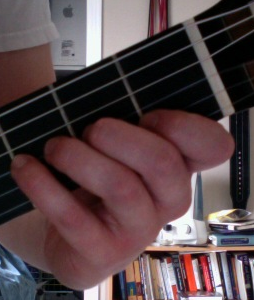
parallel hand position angled hand position

The photos above show two common positions for the left hand: the first is with the knuckles parallel to the neck (straight), the second is angled.

Common wisdom is that the hand must always be in the parallel position. I disagree.

Easy Doctrine

Once again, we’re back to easy. Sometimes an angled hand positions makes things easier. A few examples:

  1. Chords in which two fingers are stacked at the same fret. Try playing the common A minor chord with an straight vs. angled position.
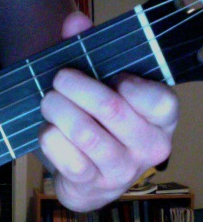
    A minor

    A minor with and angled position

    Using an angled position on this chord puts the second finger closer to its fret letting us exert less pressure on the string to get a clear sound.

  2. Playing around ninth position or above gets pretty crowded with a strictly straight position. Using an angled position can make this a bit easier.
  3. Beginners should use the fourth finger approach. This puts the hand in an angled position. In fact, most first position playing is quite a bit easier in the angled position.

More Than One Chord at a Time

There’s a sort of sliding scale of left hand positions. Sometimes a very angled position (like the one at the top of this post) works well, sometimes a more straight approach is better.

The biggest thing is to notice which is easier and where you natural use angled vs. straight position. Carefully considering and planning small scale events like how angled the left hand should be for a given chord or passage allows you to practice moving into and out of that position. In short, noticing your left hand position gives you a short cut to practice–it allows you to specifically practice the subtle changes in left hand position rather than leaving them to chance or your unconscious.

4 Responses leave one →
  1. 2010 March 24
    Daniel permalink

    Abel Carlevaro’s School of Guitar (possibly out of print?) and Masterclass books have been a revelation to me regarding left hand usage. I’ve always believed that my left hand was supposed to be in the parallel position shown in your first photo. Carlevaro writes about pivoting the hand to that make chord transitions more natural. This often has the hand in a more angled position.

    Since working with the Carlevaro books, I’ve allowed my left hand to move more freely. I make smaller movements with my fingers, letting the hand assist in placing the fingers in the proper position instead of holding that perfectly parallel position and making the fingers do all the work. It has made playing much easier.

  2. 2011 February 17
    Jon Paul Jones permalink

    First of all the “straight” position depicted in the photo above is pretty bad, the 4th finger is too straight, and the wrist has a very unhealthy looking bend in it which will no doubt lead to some tension problems if not tendinitis in the future. I would encourage anyone reading to watch videos of Grisha or Eliot Fisk on youtube ( the latter being controversial I know, but just watch the hand) and try to copy this left hand position.
    For me there is no set hand position. This is just something you tell young students so they can either break bad habits or get used to a new hand position. An experienced player has enough flexibility in his/her hand position to seamlessly move between chordal and scalar passages with the greatest efficiency, control and power.
    Also, many left hand positions are poor because of the lack of attention to increasing ones hand-strength. I think often times people think because we are playing “classical” guitar that we are now in the realm of something very delicate which should be approached with a light touch, “careful dont break it!” attitude. While this is true to a degree there is a definite need for power in the left hand, it just makes playing easier. Its like ballet, such a graceful art-form that flows like water when performed masterfully requires the dancers bodies to be pure muscle from head to toe, a necessity to pull of such demanding feats of coordination with effortless poise.

    To help with left hand position, I would suggest practicing rest-stroke descending chromatic slurs on the G-string starting at the 5th fret. A rest-stroke slur is a left hand slur in which the finger pulls off the string and lands on the fretboard, like rolling off of a log in a river. I like this pattern:
    4-3-4-2
    4-3-4-2
    3-2-3-1
    3-2-3-1

    then move up a fret. All four fingers are on the G string, on consecutive frets. Start with your metronome at 55 and play eight notes. Make sure the slurs are even, and there is no excess noise coming from the callous of the L.H.
    When the l.h. is in this “chromatic” position, with each finger on a consecutive fret on the g string, the first finger should be tilted slightly to the left, the second is pretty much vertical, the third finger slightly angled to the right, and the 4th angled more so to the right. This is just my hand, someone else might have slightly different angles. The tips of the fingers should be almost perpendicular to the fretboard, and the 4th finger is bent at both the tip joint and the middle joint. DONT STRAIGHTEN YOUR PINKY

    • 2011 February 17
      Jon Paul Jones permalink

      I guess I should have read your blog on descending slurs first!! Pretty much the same advice!

    • 2011 February 17

      Regarding the “unhealthy bend to the wrist” that’s probably because I was standing up to get the photo (via photo booth on my mac). I’m also not suggesting set hand positions: “There’s a sort of sliding scale of left hand positions.” Whatever works best for a given passage.

Leave a Reply

Note: You can use basic XHTML in your comments. Your email address will never be published.