
Secondary Dominants
In common practice period music (about 1650-1900) there a strong relationship between dominant and tonic. Normally, there’s only one dominant in each key. However, through some simple chromatic additions we can introduce chords into a key that function as dominants to chords other than tonic.
That is, in a V7 (dominant) chord we have two tendency tones the 7th and the 3rd. The 7th moves down and the 3rd moves up. So in C major (3rd in red, 7th in green):
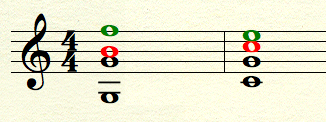
Let’s examine the dominant chord. It’s a major triad (G B D) accompanied by a minor 7th (F). By copying that sort of formula, we can apply a dominant to just about any chord. But the most common way to use these so called secondary dominants is by applying them to the V chord. The result is we get a chord labled V/V–V of five. Or the dominant of the V.
Construction
In our normal dominant, the root is a fourth below or fifth above the root tonic. This is our first step. Let’s set up or temporary “tonic”: G. A fourth below or fifth above G is D. That’s our V/V chord’s root. Here’s our progression so far:
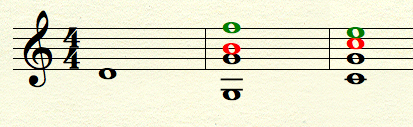
The next step is to construct a dominant 7th chord built on that root. So for the D, that means we use the pitches D F# A C (a major triad: D F# A, and a minor seventh: C).
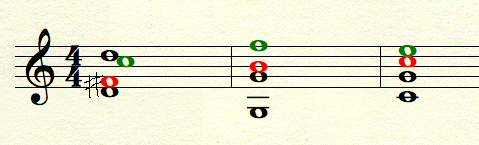
So the third of V/V (D7) moves up to the root of V (G7), and the 7th of V/V moves down to the third of V. The dominant resolves as it did above.
The Process: Cliff Notes
- Determine which chord you’d like to apply a secondary dominant to
- Find the root of the secondary dominant a fourth below/fifth above the root of the chord to which the dominant will be applied
- Build a dominant 7th chord on that root, ensure all the voices resolve correctly
A Spot of Analysis
Let’s go back to that wonderful B minor study by Fernando Sor. Measures 25 and 26 make use of a secondary dominant
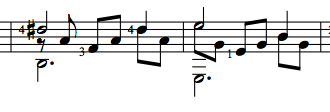
In the key of B minor we suddenly get a B7 chord, which doesn’t seem to make sense. However, it resolves to an E minor chord in measure 26. E minor is a temporary “tonic.” So have a fifth above our temporary tonic, E minor, which is B. On that B we have a dominant seventh chord. Because E minor is iv of the key of B minor we would analyze the passage like this.
| V7/iv | iv |
Sometimes secondary dominants are written without the slashes, instead using arrows:

Neil Saunders
Chris –
You write that “[b]y copying that sort of formula [i.e. the root movement V7-I], we can apply a dominant to just about any chord [with the fairly obvious exception of the unstable vii-chord in the major].” As I’m sure you’re aware, some theorists actually refer to these as Applied Dominants rather than as Secondary Dominants, although I’ll admit that the latter term is the more common of the two.
You also write about setting up a “temporary tonic” by the use of such a secondary (or applied) dominant; again, this suggests to me that you have the (rather helpful) term “tonicization” in mind for such a procedure.